The 7 Diesel Parts You Should Never Buy on Price Alone
When a diesel engine fails, the cheapest part is often the most expensive mistake. Here's where quality has to come before price.
Every week we talk with truck owners dealing with premature failures, repeat repairs, and costly downtime — because someone chose a part based solely on price.
In the heavy-duty diesel world, a $200 savings can easily turn into a five-figure repair bill if the wrong component fails at the wrong time. That's not to say the most expensive option is always the best. The key is understanding which parts are critical to engine reliability — and which ones deserve serious consideration before you pull out your wallet.
Here are seven diesel engine components where quality should always come before price.
Cylinder Heads
The cylinder head is one of the most critical — and expensive — components on any diesel engine. It seals the combustion chamber against pressures exceeding 3,000 PSI during ignition, houses your valves and injectors, and manages airflow through every power stroke.
A single overheating event is all it takes. One moment the temperature gauge climbs past normal, and by the time the engine cools down, the cylinder head has already started to warp. A poor-quality casting, inferior valve materials, or improper machining can lead to:
- Cracked heads
- Dropped valves
- Coolant leaks
- Compression loss
- Catastrophic engine damage
A dropped valve doesn't just mean a head replacement — it can destroy a piston, liner, injector, turbocharger, and sometimes the entire engine. Research in the Journal of Applied Engineering Sciences found that non-standard reconditioning procedures are the leading cause of repeated head failures after repair — meaning cheap heads often fail twice.[Goldfarb]
Ask before you buy
- What casting material is used?
- Has the head been pressure tested?
- Are the valves upgraded?
- What warranty backs the product?
Fuel Injectors
Modern diesel injectors operate under extreme pressures and impossibly tight tolerances. Cheap injectors result in poor fuel atomization, excessive smoke, rough idle, reduced fuel economy — and eventually, piston damage from over-fueling. A bad injector doesn't just hurt performance; it damages expensive engine components over time.
Injector problems usually start with small performance issues that become more noticeable over time. If the root cause isn't addressed, new injectors can fail quickly after installation.[HHP]
Always buy injectors from reputable manufacturers and suppliers who can verify proper calibration and testing procedures. New, remanufactured, and OEM all have their place — but the supplier's reputation and testing process matter as much as the brand name on the box.
Turbochargers
The turbocharger delivers the airflow your engine needs to make power efficiently. On a modern diesel semi it's far more than a power adder — it's the engine's primary exhaust manager, controlling exhaust temperature, air-fuel ratio, soot production, EGR function, DPF regeneration, and SCR efficiency.[TruckClub]
That means a turbo failure is rarely just a turbo problem. It often starts a chain reaction that damages or destroys multiple aftertreatment parts in a very short window.
Around 30% of diesel engine failures in Class 8 trucks are linked to turbocharger issues — and a worn turbo can cut engine power by up to 50%.
Low-quality turbochargers frequently suffer from bearing failures, compressor wheel damage, oil leakage, and excessive shaft play. When comparing turbos, focus on manufacturing quality, balancing procedures, warranty coverage, and supplier reputation — not just the sticker price.
Overhaul Kits
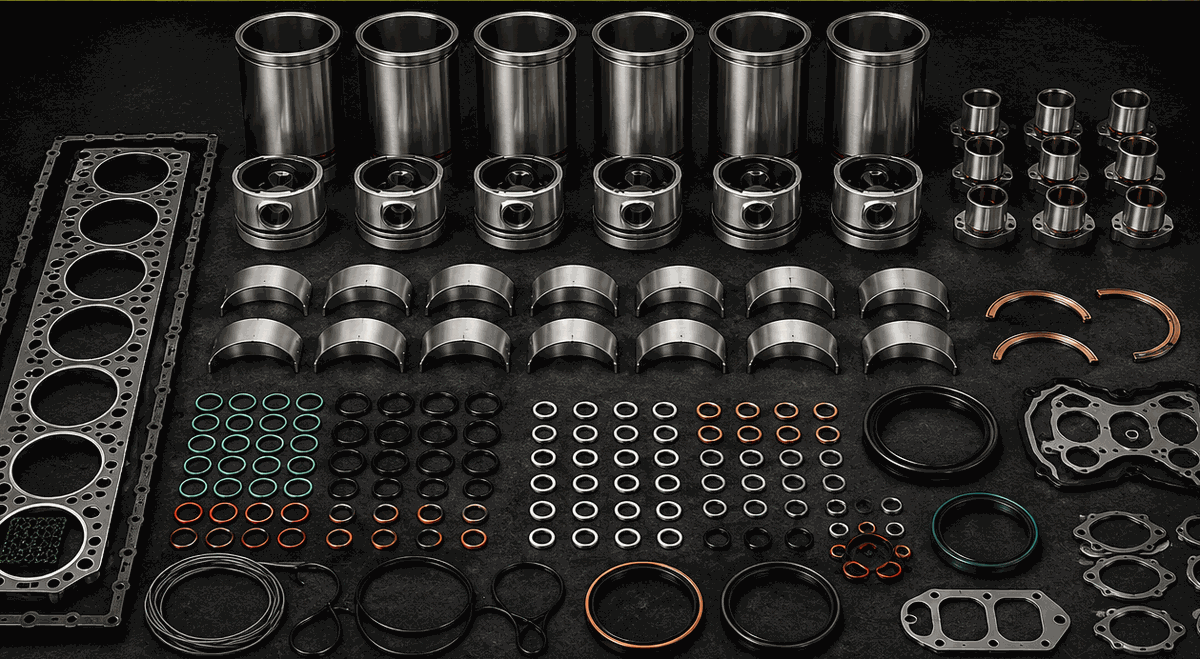
An overhaul kit contains the components that determine whether your rebuild lasts 100,000 miles or 1,000,000 miles. Critical components include pistons, liners, rings, bearings, gaskets, and seals. Poor-quality kits lead to oil consumption, premature wear, compression issues, and bearing failures.
A properly rebuilt heavy-duty diesel engine — with quality parts, proper machining, and correct break-in — can last 400,000 to 600,000 miles. Some well-maintained rebuilds reach 750,000+ miles before the next overhaul.[FleetRabbit]
Head Gaskets & Sealing Components
Head gaskets are often overlooked because they're inexpensive compared to major engine components. That's exactly what makes them dangerous to cheap out on. When a head gasket fails, the consequences are severe: coolant contamination, oil contamination, overheating, and engine damage that cascades fast.
Premium sealing components are engineered to withstand the extreme temperatures and combustion pressures found in modern diesel engines. The cylinder head seals the combustion chamber against forces exceeding 3,000 PSI during ignition — and by the time symptoms appear, damage is often severe enough to require a costly rebuild or full replacement.[Heavy Duty Kits]
This is one area where saving a few dollars almost never makes sense.
Bearings
Bearings are literally what keep your crankshaft alive. They operate under enormous loads every second the engine is running — and inferior bearing materials or poor manufacturing have one predictable outcome: low oil pressure, excessive wear, spun bearings, or complete engine failure.
They're small. The consequences aren't. Always choose proven brands and quality materials when rebuilding a diesel engine.
Fasteners & Head Bolts
Many rebuilders spend thousands on premium engine components and then try to save money on the hardware holding everything together. That's a mistake.
Head bolts and studs maintain clamping force under extreme temperatures and cylinder pressures. Substandard fasteners can lead to head gasket failures, loss of clamping force, coolant leaks, and repeat repairs that put you right back on the lift with a bill you already paid once.
A quality fastener set is cheap insurance compared to the labor involved in tearing down a head a second time.
How to Evaluate Diesel Parts Beyond Price
Instead of asking “What is the cheapest option?” — ask:
Six questions before you buy
- Who manufactured it?
- What materials were used?
- Has the design been proven or improved?
- What warranty backs it?
- What is the supplier's reputation?
- How many customers are successfully running it?
The true cost of a diesel part includes downtime, labor, reliability, warranty support, replacement costs, and lost revenue. Fleets that push rebuilds further out replace injectors earlier to keep spray patterns sharp, fix minor turbo issues immediately instead of letting imbalance destroy bearings, and base maintenance on engine hours instead of just miles — because vocational trucks age by hours.[TruckClub]
For fleets and owner-operators, uptime is far more valuable than the initial savings from choosing the cheapest component available.
The Bottom Line
Not every diesel part needs to be premium. But cylinder heads, injectors, turbochargers, overhaul kits, head gaskets, bearings, and fasteners directly affect engine reliability and longevity. They should always be purchased based on quality, engineering, and supplier reputation — not price alone. The cheapest part is only a bargain if it performs like the expensive one. If it doesn't, it becomes the most expensive part you ever bought.